By Achievers Alchemy
Let’s be honest for a second. How many times have you Googled “how to be happier” at 11pm while doom-scrolling through someone else’s highlight reel on Instagram? Yeah, same.
Here’s the thing: happiness isn’t something that just happens to you. It’s not hiding inside a new handbag, a better job title, or a perfectly filtered vacation photo. Happiness is something you build — one small, intentional habit at a time.
The good news? You don’t need a life overhaul to get started. You just need a few solid habits that you can actually stick to. So grab your coffee (or your green tea, no judgment here), and let’s talk about the habits that genuinely move the needle on happiness.
1. Stop Letting Your Ego Run the Show
Okay, this one might sound a little deep for a Tuesday morning, but stick with me.
A lot of our unhappiness comes from comparing ourselves to others — she has a nicer apartment, she got promoted faster, her Instagram looks like a magazine shoot. That constant measuring and comparing? That’s your ego talking, and it is exhausting.
Here’s a simple reality check: when you catch yourself comparing, ask yourself “Does this actually affect my life?” Does your neighbor’s fancy car change anything about your day? Does someone else’s success make yours any less real? Nope and nope.
Try this: Next time you feel that comparison creep in, pause and write down three things you’re genuinely proud of in your own life. Not things you want — things you have. It feels a little silly the first time, but it works.
2. Make Gratitude a Daily Non-Negotiable
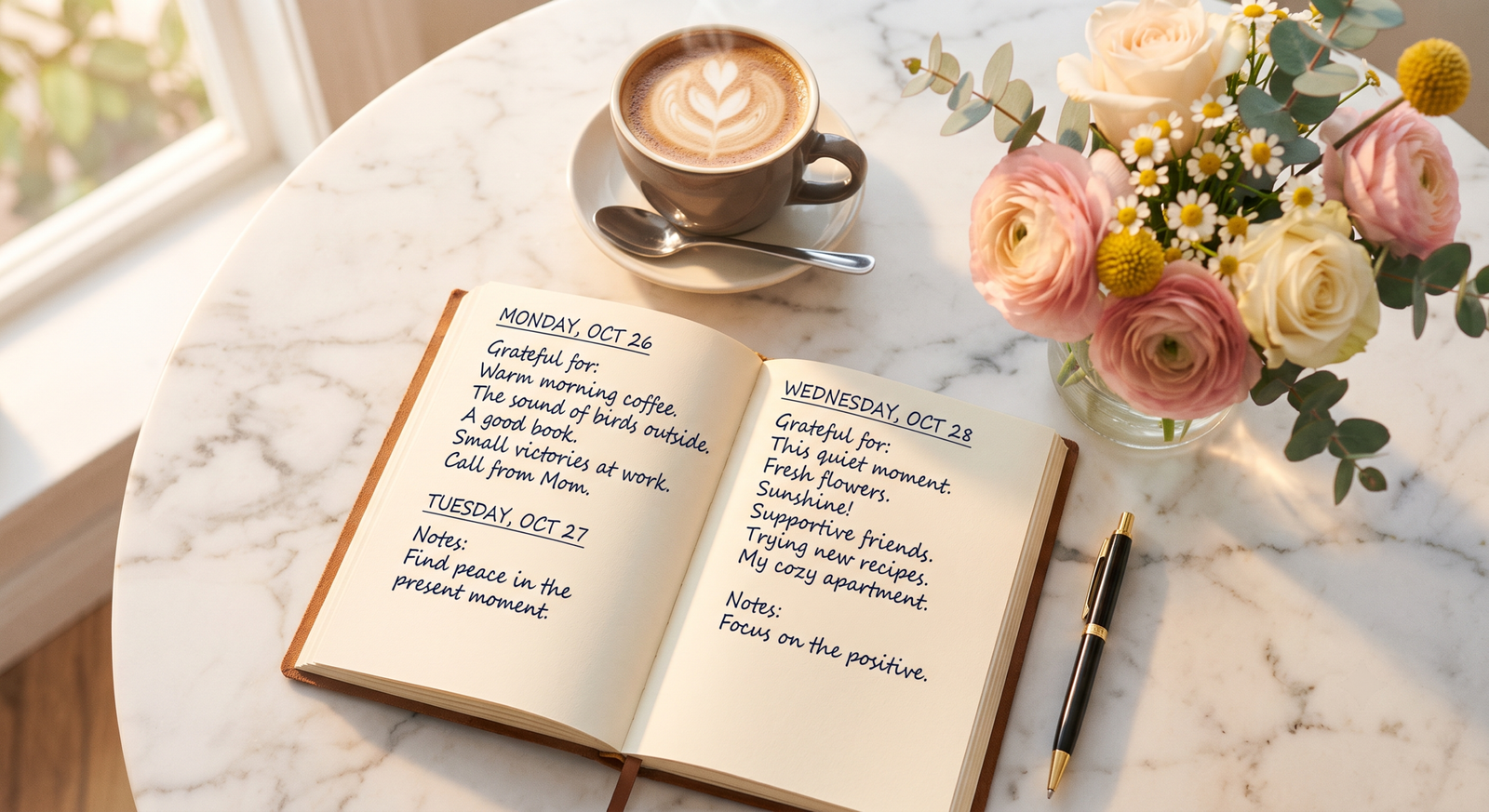
Here’s something that sounds almost too simple to be true: writing down what you’re grateful for every single day will genuinely make you happier. Research backs this up, and the Everyday Happiness workbook puts it perfectly — the more thankful you are, the happier you’ll feel.
This isn’t about toxic positivity or pretending everything is fine when it isn’t. It’s about training your brain to notice the good stuff that’s already there.
Think about it: your brain is wired to look for problems. That’s actually a survival mechanism left over from way back when we were avoiding predators. The problem is, in modern life, your brain treats a passive-aggressive email from a coworker the same way it would treat a lion. Gratitude is how you manually override that.
Try this: Every morning or night, write down just three things you’re grateful for. Be specific! Not just “I’m grateful for my family” but “I’m grateful that my sister texted me a meme that made me snort-laugh.” The more specific, the more your brain actually feels it.
3. Move Your Body (Even Just a Little)
You knew this was coming, right? But here’s the thing — nobody is asking you to run a marathon.
Movement is one of the fastest, most reliable mood-boosters available to you, and it’s completely free. When you exercise, your body releases feel-good chemicals that reduce stress, lift your mood, and help you sleep better. Even a 20-minute walk counts.
The Transform Your Life ebook makes a great point about this: the biggest mistake people make is trying to do too much too soon. You don’t need to become a gym person overnight. Start with what feels good. Walk through your neighborhood. Dance in your kitchen while dinner cooks. Do some stretching before bed. Just move.
Try this: Commit to 15-20 minutes of movement three times this week. That’s it. No pressure, no perfection — just showing up for your body in a small way. Notice how you feel afterward. Chances are, pretty good.
4. Feed Your Brain, Not Just Your Belly
What you eat has a much bigger impact on how you feel emotionally than most people realize. We’re not talking about going on a diet here — we’re talking about nourishing yourself.
Did you know that a huge portion of people are deficient in nutrients like magnesium and Vitamin D? Magnesium alone helps with sleep, brain function, and mood. And Vitamin D deficiency is actually linked to low mood and fatigue. So if you’ve been wondering why you feel “blah” all the time, it might literally be what’s on (or not on) your plate.
This doesn’t have to be complicated. Swapping one processed snack for some eggs, avocado, or a handful of nuts a few times a week can actually make a real difference in your energy and your mood.
Try this: Add one “real food” meal to your week that you cook from scratch. Even a simple chicken stir-fry with veggies. Bonus points if you take a daily multivitamin to fill any gaps. Small changes, real results.
5. Get Your Mind Right with Mindfulness
Okay, before you roll your eyes — mindfulness doesn’t have to mean sitting cross-legged on a meditation cushion chanting. It just means learning to be here, in this moment, instead of mentally time-traveling to every worry, regret, or “what if.”
Here’s a relatable example: You’re washing dishes, but in your head, you’re already replaying that awkward thing you said three years ago AND pre-worrying about next week’s meeting. Sound familiar? That’s the opposite of mindfulness — and it’s a happiness killer.
Mindfulness simply means noticing when your thoughts drift and gently bringing yourself back. Over time, this lowers stress, improves focus, and yes — genuinely makes you happier.
Even five minutes a day makes a difference. Apps like Headspace or Calm can guide you if you’re not sure where to start.
Try this: Tomorrow morning, before you check your phone, sit quietly for five minutes. Breathe in slowly, breathe out slowly. When thoughts pop up (they will), just notice them without getting caught up in them, and come back to your breath. Five minutes. You’ve got this.
6. Design a Life You Actually Like
This one’s big, so let’s break it down simply.
You can have all the habits in the world, but if the structure of your daily life is working against you, happiness will always feel just out of reach. That means taking a real look at the basics:
- Do you have enough money for your actual needs? Financial stress is a legitimate happiness blocker. Not having a Lamborghini isn’t the problem — not being able to pay rent is. If money stress is real for you, making a plan (even a small one) will help you feel more in control.
- Do you have people in your life who lift you up? Surround yourself with people who genuinely support you. The Everyday Happiness workbook says it plainly: the right people can add to your happiness enormously, and the wrong people can do the opposite. You are allowed to be selective about who gets your time and energy.
- Do you have enough free time to breathe? A packed schedule with no space for yourself is a recipe for burnout. Protect your downtime like it matters — because it does.
Try this: Look at your week and identify one thing that consistently drains you. Can you reduce it, delegate it, or let it go? And identify one person who makes you feel genuinely good. Can you make more time for them?
💡 Struggling to stay consistent with your habits? It happens to all of us — and it’s not about willpower. Head over to our article How to Stay Motivated Even When You Really Don’t Feel Like It to learn exactly how to get back on track and keep going even when life gets in the way.
7. Have Something to Look Forward To
This is such a simple but underrated happiness habit: give yourself things to look forward to. Not someday — soon.
It doesn’t have to be a trip to Paris (though absolutely yes if you can swing it). It could be a movie night you’ve planned, a new book you’re saving for the weekend, a girls’ brunch you have on the calendar, or even just a new recipe you’re excited to try.
Having things ahead of you that excite you keeps life feeling alive and purposeful. When everything feels like the same routine on repeat, motivation and happiness both take a hit.
Try this: Right now, plan ONE thing to look forward to in the next two weeks. Put it in your calendar. Give it a fun name. And actually do it — no canceling on yourself!
8. Take Responsibility (This Is the Empowering One)
This might be the habit that changes your life the most, so read this slowly.
It is so easy — and so tempting — to blame outside circumstances for how things are going. Your boss, your upbringing, the economy, your partner, bad luck. And sometimes, honestly, things really aren’t your fault.
But here’s the powerful shift: when you take responsibility for your life — not blame, not guilt, but ownership — you get your power back. Because if it’s your life, you can change it. If you’re always waiting for someone or something else to change first, you’re stuck.
The Everyday Happiness book puts this perfectly: when someone else is responsible, you give yourself permission to be inactive. When you’re responsible, you have the power to make changes.
Try this: Think of one area of your life where you’ve been waiting for something external to change. Ask yourself: “What’s one small thing I could do this week to improve this?” Then do that one thing.
9. Build a Morning Routine You Actually Love
The way you start your morning sets the tone for your entire day. And no, you don’t need to wake up at 5am to “win” at life.
What you DO want is a morning that feels intentional — not a mad scramble where you’re checking emails before your feet hit the floor and rushing out the door with no breakfast.
A great morning routine doesn’t have to be long or complicated. Even 20 intentional minutes can be transformative. Think: gratitude journal, a few minutes of movement, a nourishing breakfast, and something that makes you smile (a podcast you love, your favorite playlist, a moment outside).
When you build a morning routine that works for you, you’re essentially telling yourself: I matter. My day matters. And that mindset carries forward.
Try this: Design your ideal 20-minute morning routine on paper. What would it include? Try it for just one week and notice how it changes your mood.
💡 Ready to stop playing small and start going after the things you actually want? Read our article How to Overcome Fear and Start Taking the Chances That Change Your Life — it’s the perfect companion to this one.
10. Let Go of What’s No Longer Serving You
Last but maybe most important — let go.
Let go of the grudge you’ve been carrying since 2019. Let go of the idea that you have to have everything figured out. Let go of the friendship that’s felt more draining than uplifting for years. Let go of the story you’ve been telling yourself about what you can and can’t do.
Letting go doesn’t mean things didn’t matter or didn’t hurt. It just means you’re choosing not to let the past take up space in your present. Every bit of mental energy you spend on things you can’t change is energy stolen from the life you’re actually living right now.
The Everyday Happiness workbook describes it beautifully: the simplest way to let go is to breathe and stay with the feelings until they subside. You don’t have to force it — you just stop feeding it.
Try this: Write down one thing you’ve been holding onto that no longer serves you. Then write down what your life could look and feel like without that weight. Sometimes just naming it starts the release.
You’ve Got This
Here’s the beautiful truth about all of this: you don’t need to do all ten of these habits perfectly tomorrow. You just need to start with one. Pick the one that resonated most and commit to it for the next week. That’s it.
Happiness isn’t a destination — it’s a practice. And you are more than capable of building a life that feels genuinely, authentically good. Not perfect, but yours. Alive, meaningful, and full of things that matter to you.
You’re already here, reading this, looking for ways to grow. That means you’re already on the path.
Now go take that first step. 💛
Was this helpful? Save it, share it with a friend who needs it, or drop a comment below — we love hearing from you! And if you’re ready to go deeper on any of these habits, explore more over at Achievers Alchemy.